India Building Materials Market Size, Industry Trends, Growth Outlook and Forecast 2026–2034
Market Overview & Summary
The India building materials market size was valued at USD 44.4 Billion in 2025. Looking forward, the market is projected to reach USD 64.5 Billion by 2034, exhibiting a compound annual growth rate (CAGR) of 4.24% during 2026-2034. The industry is experiencing robust growth driven by rapid urbanization, extensive infrastructure development, and increasing construction activities across the residential and commercial sectors. There is a notable industry-wide inclination toward sustainability, propelled by environmental concerns and strict regulatory policies. The escalating demand for green building materials such as fly ash bricks, low-carbon cement, and recycled concrete alongside technological advancements like smart and high-performance materials, continues to fundamentally shape and sustain market momentum nationwide.
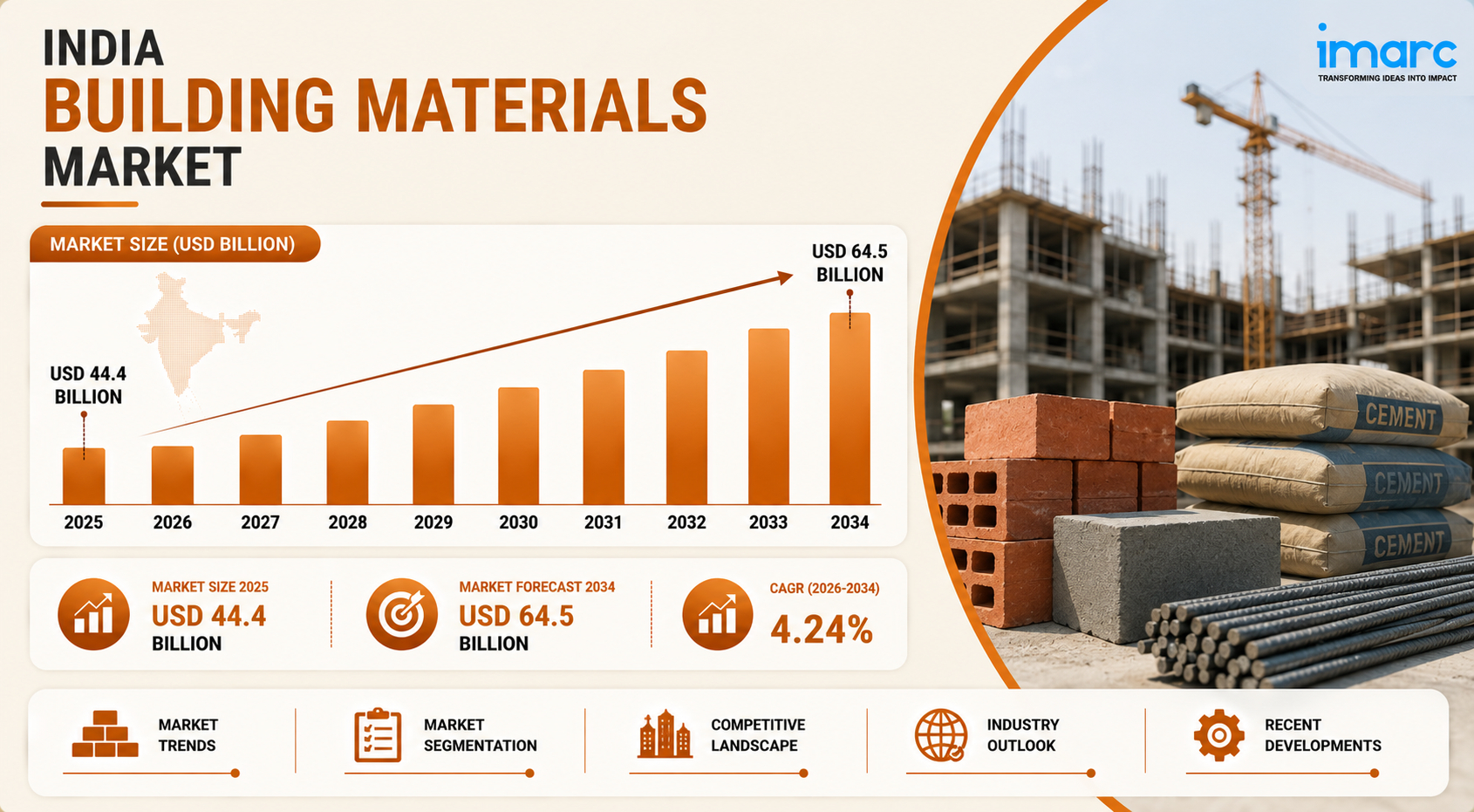
Market Size & Forecast:
-
Market Size (2025): USD 44.4 Billion
-
Projected Market Size (2034): USD 64.5 Billion
-
CAGR (2026 - 2034): 4.24%
-
Leading Regional Market: North India
Key Market Trends:
-
Surge in Eco-Friendly and Sustainable Materials: The industry is witnessing a rapid structural shift toward green building solutions due to rising environmental awareness and government initiatives. Developers are increasingly adopting recycled aggregates, bamboo, and fly ash-based cement to drastically reduce carbon footprints, aligning with regulatory frameworks like the Energy Conservation Building Code (ECBC).
-
Integration of Smart and High-Performance Materials: Technological innovations are actively transforming traditional construction practices. The growing integration of self-healing concrete, nano-engineered coatings, and phase change materials (PCMs) is significantly improving structural longevity, energy efficiency, and overall occupant comfort across modern commercial and residential infrastructure.
-
Growth of Modular and Prefabricated Construction: There is an escalating demand for prefabricated and modular building materials. These solutions offer accelerated construction timelines, minimized on-site material wastage, and enhanced quality control. This trend is particularly popular in large-scale commercial real estate and affordable housing projects requiring rapid execution and strict cost management.
-
Impact of Green Building Certifications: The intense focus on securing green certifications, such as the Indian Green Building Council (IGBC) and LEED ratings, is generating urgency in adopting sustainable materials. In 2024, India certified 370 projects to LEED specifications, ranking third globally, which directly boosts the bulk procurement of compliant eco-friendly materials.
-
Rise in Energy-Efficient Climate Solutions: Expanding upon basic structural needs, architects are prioritizing energy-efficient designs utilizing insulated concrete forms (ICFs), autoclaved aerated concrete (AAC) blocks, and high-performance glass. These materials provide superior thermal insulation, drastically minimizing the dependence on artificial heating and cooling systems in India's diverse climatic zones.
➤ Request Sample Report (TOC & Charts): https://www.imarcgroup.com/india-building-materials-market/requestsample
Strategic Market Dynamics:
Growth Drivers:
-
Rapid Urbanization and Real Estate Expansion: The continuous migration of populations to urban centers creates immense demand for residential and commercial real estate. This ongoing building boom necessitates the large-scale consumption of foundational materials like cement, steel, and bricks to support high-density urban housing networks.
-
Aggressive Government Infrastructure Initiatives: Massive public sector capital allocation toward smart city projects, highway expansions, and the "Housing for All" scheme serves as a primary volume driver. These state-backed mega-projects guarantee long-term order books for material manufacturers and suppliers.
-
Transition Toward Sustainable Construction Practices: Surging environmental consciousness among modern consumers and regulatory mandates actively propel the green building segment. The long-term economic and environmental benefits of low-carbon footprint materials incentivize developers to permanently shift away from traditional, highly polluting construction supplies.
-
Advancements in Manufacturing and Automation: Modernized production facilities utilizing advanced robotics and automation ensure higher precision, faster output, and reduced human error in material manufacturing. These enhanced capabilities allow suppliers to seamlessly meet the rapidly scaling domestic demand for high-grade construction components.
Market Restraints:
-
High Initial Costs of Advanced Green Materials: While sustainable and smart building materials offer long-term savings, their initial procurement and installation costs remain significantly higher than conventional alternatives. This steep price premium often deters widespread adoption among budget-constrained developers and mid-tier regional contractors.
-
Supply Chain Vulnerability and Raw Material Price Volatility: The manufacturing of basic building materials is heavily dependent on the stable supply of raw commodities like limestone, iron ore, and fossil fuels. Fluctuations in global commodity prices and localized supply chain disruptions can severely compress manufacturer profit margins.
-
Shortage of Specialized and Skilled Labor: The integration of advanced, high-performance materials and complex modular systems requires a highly trained workforce for proper installation. A persistent structural deficit of specialized labor can lead to faulty construction, project delays, and compromised structural integrity.
➤ Explore the Full Report with Charts, Table of Contents, and List of Figures: https://www.imarcgroup.com/india-building-materials-market
Competitive Landscape & Key Company Insights:
The India building materials market features a highly competitive and concentrated landscape, characterized by established national cement manufacturers, large-scale steel conglomerates, and specialized eco-friendly material producers. Companies compete aggressively on production capacity, logistics efficiency, sustainability credentials, and the expansion of pan-India distribution networks. Market leaders are heavily prioritizing investments in low-carbon manufacturing processes, adopting renewable energy across their plants, and securing lucrative bulk supply contracts for government infrastructure projects. Continuous investments in strategic regional expansions and advanced product diversification remain critical for maintaining competitive advantage and driving volume growth.
Deep-Dive Segment Insights:
Type Insights:
-
Cement
-
Bricks
-
Aggregates
-
Metals
-
Others
Cement dominates the market type segment, acting as the indispensable foundational binder for virtually all structural concrete applications across residential, commercial, and civil infrastructure developments.
Application Insights:
-
Residential
-
Commercial
-
Industrial
The residential sector holds a commanding market share, continuously driven by population growth, rapid urbanization, rising disposable incomes, and the persistent national demand for affordable and premium housing.
Region Insights:
-
North India
-
South India
-
East India
-
West India
North India and West India represent substantial regional markets, propelled by dense populations, extensive metropolitan commercial real estate development, and massive government-backed transit and highway infrastructure projects.
Recent News and Developments:
-
March 2025: SIAM Cement BigBloc Construction Technologies Pvt Ltd, a joint venture between BigBloc Construction Ltd and SCG International Corporation Co., Ltd. of Thailand, commenced operations in India with the commercial production of its first plant in Kheda, Gujarat. The project features India's first AAC Wall Plant, backed by an investment of approximately INR 65 Crore, and boasts an annual capacity of 2.5 Lakh cubic meters to introduce advanced building materials to the domestic market.
-
February 2025: Titan Cement Group announced a strategic joint venture with JAYCEE, an India-based cement materials provider, to significantly expand its foothold across the South Asian market. This collaboration focuses on producing, sourcing, and distributing supplementary cementitious materials, enabling the development of sustainable construction infrastructure by utilizing eco-friendly substitutes for traditional clinker-based cement.
-
September 2024: Interarch Building Products officially unveiled its new, state-of-the-art manufacturing facility in Andhra Pradesh. This expansion is specifically targeted at increasing the production capacity for pre-engineered steel structures, metal roofing, and advanced cladding solutions to meet the growing regional demand.
Customization Note: If you require any specific information not covered within this report's scope, we will provide it as part of the customization.
➤ Request Report Customization: https://www.imarcgroup.com/request?type=report&id=29287&flag=E
Frequently Asked Questions (FAQ)
Q1. How big is the building materials market in India?
Ans. The building materials market in India was valued at USD 44.4 Billion in 2025.
Q2. What is the future outlook of the building materials market in India?
Ans. The market is projected to reach USD 64.5 Billion by 2034, exhibiting a growth rate (CAGR) of 4.24% during 2026-2034.
Q3. What are the key factors driving the building materials market in India?
Ans. Rapid urbanization, infrastructure development, increasing real estate investments, and surging demand for sustainable, energy-efficient materials are the primary growth drivers.
Q4. Which segment leads the market by application?
Ans. The residential segment leads the market, propelled by continuous population growth, urbanization, and robust demand for modern housing developments.
Q5. How is sustainability impacting the market? Ans. Sustainability is fundamentally transforming the sector, with developers rapidly adopting green materials like fly ash bricks and recycled aggregates to meet eco-friendly regulatory standards and IGBC/LEED certifications.
Strategic Insight & Verdict:
Through our analysis, we observe that the India building materials market is currently undergoing a massive structural transformation, scaling robustly due to relentless urbanization and aggressive government infrastructure spending. The most defining shift within the industry is the rapid, widespread transition toward sustainability and energy efficiency, heavily influenced by strict environmental regulations and the global push for green building certifications. As traditional construction paradigms give way to advanced, high-performance, and modular materials, the total cost of ownership and structural longevity are drastically improving. Companies that strategically prioritize low-carbon manufacturing innovations, expand their eco-friendly product portfolios, and align seamlessly with national smart city initiatives are exceptionally well-positioned to command significant market share over the forecast period.