India Protein-based Product Market Size, Share Analysis, Industry Trends, Growth Outlook and Forecast 2026–2034
India Protein-based Product Market: Outlook
The report titled "India Protein-based Product Market Size, Share, Trends and Forecast by Type, and Region, 2026–2034" comprises the overall market analysis of India, size, growth trends, key drivers, and regional insights of the India protein-based product market and other important aspects related to the report.
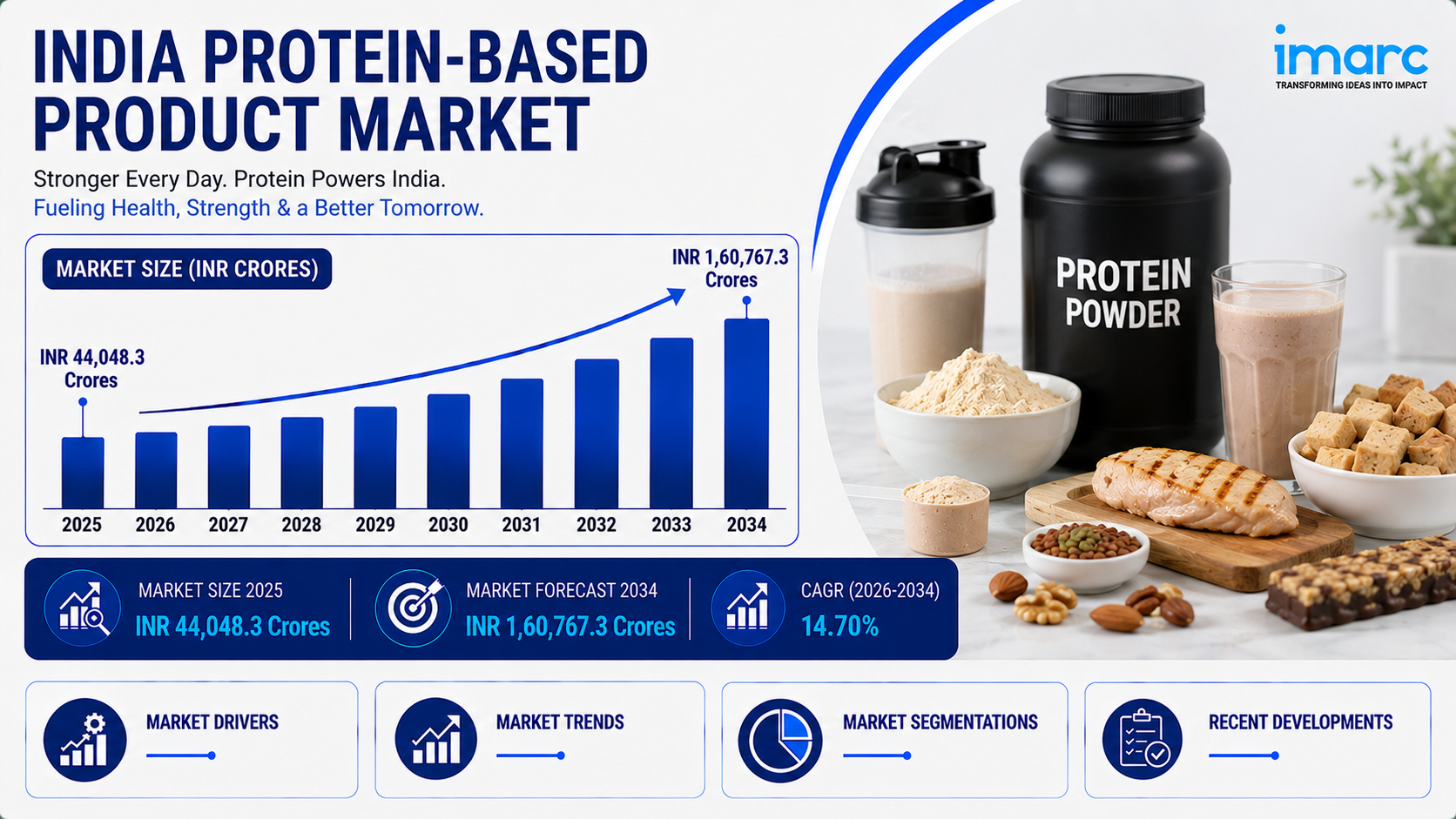
How Big is the India Protein-based Product Market?
The India protein-based product market size reached INR 44,048.3 Crores in 2025. Looking forward, IMARC Group expects the market to reach INR 1,60,767.3 Crores by 2034, exhibiting a massive growth rate (CAGR) of 14.70% during 2026–2034. The market is experiencing robust expansion driven by the aggressive mainstream adoption of high-protein diets, the normalization of sports nutrition beyond niche fitness circles, and widespread innovation in plant-based and fortified everyday food segments.
What are the Key Developments and Emerging Trends in the India Protein-based Product Market?
-
Third-Party Certification and "Clean Label" Purity:
With rising concerns over adulteration, consumers are actively demanding Informed-Sport and independent third-party lab certifications. Brands are heavily emphasizing ingredient transparency, highlighted by recent launches like TrueBasics' 'Clean Whey' (June 2025), which explicitly targets quality-conscious buyers seeking verified, banned-substance-free protein formulations.
-
Localization Through India-Specific Flavors:
To encourage everyday consumption and differentiate from global giants, domestic brands are innovating with highly localized flavor profiles. The rapid introduction of flavors like kesar badam, kulfi, masala chai, and Alphonso mango (supported by heavy digital influencer campaigns) is successfully making daily protein supplementation highly appealing to the traditional Indian palate.
-
Gym-Channel Direct Integration and D2C Subscriptions:
Brands are moving beyond traditional retail by forging direct partnerships with fitness centers for on-site sampling and trainer-led endorsements. Concurrently, companies are building recurring Direct-to-Consumer (D2C) subscription models tied to fitness communities and personalized nutrition guidance, aggressively driving customer lifetime value and brand loyalty.
-
Quick-Commerce Penetration in Regional Hubs:
The exponential rise of 10-minute quick-commerce delivery platforms is democratizing access to protein supplements. These apps are enabling instant, impulse purchases of protein bars, ready-to-drink shakes, and single-serve powder sachets across Tier-2 and Tier-3 cities where modern retail shelf space remains highly limited.
➤ Request Sample Report (TOC & Charts): https://www.imarcgroup.com/india-protein-based-product-market/requestsample
What Factors are Driving Growth in the India Protein-based Product Market?
-
Explosive Expansion of the Commercial Fitness Industry:
India's active fitness population is experiencing unprecedented growth. The country recorded nearly 13.6 million paid gym members in 2025/2026, a base that is projected to almost double to 23.3 million by 2030. This massive influx of active gym-goers creates a huge, captive audience reliant on whey protein for muscle recovery.
-
Government-Backed Sports Infrastructure (Khelo India):
Grassroots physical activity is being heavily accelerated by federal programs like the Fit India Mission and Khelo India. Continuous government funding in sports development and synthetic tracks across schools and communities is directly driving the foundational demand for performance-based sports nutrition among youth and emerging athletes.
-
Policy-Led Protein Fortification in Everyday Staples:
The government is actively embedding nutrition into the national food supply. Supported by FSSAI's fortification regulations and massive budget allocations for the Poshan Abhiyaan scheme, food manufacturers are increasingly incentivized to introduce affordable protein-fortified atta (wheat flour), biscuits, and edible oils to combat widespread dietary deficiencies.
-
Normalization of Supplementation Beyond Athletes:
Protein is successfully breaking out of the niche bodybuilding demographic. Catalyzed by a post-pandemic focus on immunity, working professionals, busy parents, and the geriatric population are adopting protein powders and shakes for basic metabolic health and muscle maintenance, vastly broadening the overall addressable consumer base.
How will the India Protein-based Product Market Evolve in the Coming Years?
The India protein-based product market is positioned for explosive and sustained expansion throughout the forecast period, transitioning from a fragmented, import-reliant sector into a highly organized, domestically robust nutritional industry. The convergence of plant-based ingredient innovation, favorable government fortification policies, and aggressive digital retail penetration will heavily compound long-term market viability.
The market generated a revenue of INR 44,048.3 Crores in 2025 and is projected to reach INR 1,60,767.3 Crores by 2034, growing at a compound annual growth rate (CAGR) of 14.70% from 2026–2034. Animal and dairy proteins will indisputably maintain volumetric dominance due to legacy consumer trust and superior amino acid profiles, while plant-based formulations will continuously capture emerging wellness demographics.
➤ Explore the Full Report with Charts, Table of Contents, and List of Figures: https://www.imarcgroup.com/india-protein-based-product-market
Deep-Dive Segment Insights
By Type: The India protein-based product market by type is segmented into Animal and Dairy Protein (Processed Chicken, Whey Protein, Cheese, Processed Fish, Casein Protein, Egg Protein), Plant Protein (Soy, Pea, Rice), and Blended Protein.
-
Animal and Dairy Protein: This segment represented the absolute largest market share in 2025. This commanding leadership is heavily driven by India's status as the world's largest milk producer, providing massive domestic access to whey and casein streams. Furthermore, whey isolates remain the undisputed gold standard for athletic muscle recovery due to their exceptionally high bioavailability and complete amino acid profiles.
By Region: The India protein-based product market by region is segmented into South India, North India, West and Central India, and East India.
-
South India: Represents the dominant market leader in 2025. This regional supremacy is directly fueled by a highly health-conscious population, a massive concentration of elite sports and fitness facilities, and a rapidly escalating urban vegan population in technology hubs like Bengaluru and Chennai.
Competitive Landscape & Key Company Insights:
The India protein-based product market exhibits a highly competitive, dynamic landscape heavily contested by massive legacy dairy cooperatives, global sports nutrition giants, and agile digital-first D2C startups. Established FMCG players maintain deep consumer trust and unparalleled physical distribution networks, heavily dominating the everyday fortified food and beverage categories. Conversely, global brands and niche D2C labels capture the premium fitness segments by aggressively prioritizing absolute ingredient transparency, rigorous third-party lab testing, and targeted digital community marketing.
Leading industry participants actively shaping the competitive environment include:
- Bio Nutrients (India) Pvt. Ltd.
- Glanbia Performance Nutrition (India) Pvt. Ltd.
- Hershey India Pvt. Ltd.
- MuscleBlaze
- MyProtein
- Nestle India
- Patanjali Foods Ltd (Patanjali Ayurved)
- Rite Bite Max Protein (Naturell India Pvt. Ltd.)
- Urban Platter
- Taali Foods India
- Nourish Organic Foods Pvt. Ltd.
- GetmyMettle (Swashthum Wellness Pvt. Ltd.)
- Plantvita
- Myfitness
- Gooddot
- Plantaway
- Wakao Foods
- Xterra Nutrition
Recent Developments
-
Premium Brand Collaborations (August 2025): Myprotein executed a strategic three-year collaboration with the heritage milkshake brand Keventers. This unique partnership was specifically designed to leverage localized flavors and combat prevalent consumer myths surrounding protein supplementation, blending international premium positioning with deep-rooted domestic brand trust.
-
Push for Ingredient Transparency (June 2025): Addressing the surging consumer demand for absolute nutritional purity, prominent domestic challengers like TrueBasics successfully launched their 'Clean Whey' portfolio. This strategic product introduction heavily emphasized transparent sourcing and additive-free formulations to capture younger, highly health-conscious consumers shifting away from legacy artificial ingredients.
-
Massive Plant Protein Capacity Expansion (2025): Global yeast and protein extract major Angel Yeast announced significant capacity expansions targeting the surging plant protein sector. With plans to increase its protein content to 85% and operate a facility producing 11,000 tons annually, the company aims to aggressively supply the booming alternative protein ingredient market.
Customization Note: If you require any specific information not covered within this report's scope, we will provide it as part of the customization.
➤ Request Report Customization: https://www.imarcgroup.com/request?type=report&id=8349&flag=E
Frequently Asked Questions (FAQs):
Q1. How big is the protein-based product market in India?
The India protein-based product market size reached INR 44,048.3 Crores in 2025.
Q2. What is the expected growth rate of the India protein-based product market?
The market is projected to expand at a compound annual growth rate (CAGR) of 14.70% during the 2026–2034 forecast period, reaching an estimated INR 1,60,767.3 Crores by 2034.
Q3. What factors are driving the growth of the India protein-based product market?
The market is primarily propelled by rising health and wellness consciousness, the mainstream adoption of high-protein diets, expanding urban fitness culture, and a significant consumer pivot toward clean-label and plant-based nutrition alternatives.
Q4. Which type segment holds the most potential in the India protein-based product market?
The Animal and Dairy Protein segment commands the largest market share, heavily supported by the widespread consumption of whey and casein proteins for superior muscle recovery and athletic performance.
Q5. Which region leads the India protein-based product market?
South India represents the largest regional market, driven by a dense concentration of modern fitness infrastructure, high disposable incomes, and a rapidly growing eco-conscious consumer base demanding both premium dairy and vegan protein products.
Strategic Insight & Verdict
Through comprehensive data analysis, we have observed that the strategic transition toward transparent, clean-label sports nutrition and mass-market fortified everyday staples represents the most lucrative frontier for stakeholders. Institutional investors and FMCG manufacturers must prioritize capital deployment into localized plant-protein extraction capabilities, gut-friendly formulation R&D, and aggressive omnichannel distribution networks. Leveraging the massive cultural shift toward preventative wellness and deeply integrating within India's expanding digital quick-commerce ecosystem will remain the definitive path for securing absolute market dominance through 2034.