India Scratch-Resistant Glass Market Size, Share, Growth and Outlook 2026-2034 | Get Sample Report
According to IMARC Group's report titled "India Scratch-Resistant Glass Market Size, Share, Trends and Forecast by Product Type, Application, and Region, 2026-2034", the report offers a comprehensive analysis od the industry, including market share, forecast, growth, and regional insights.
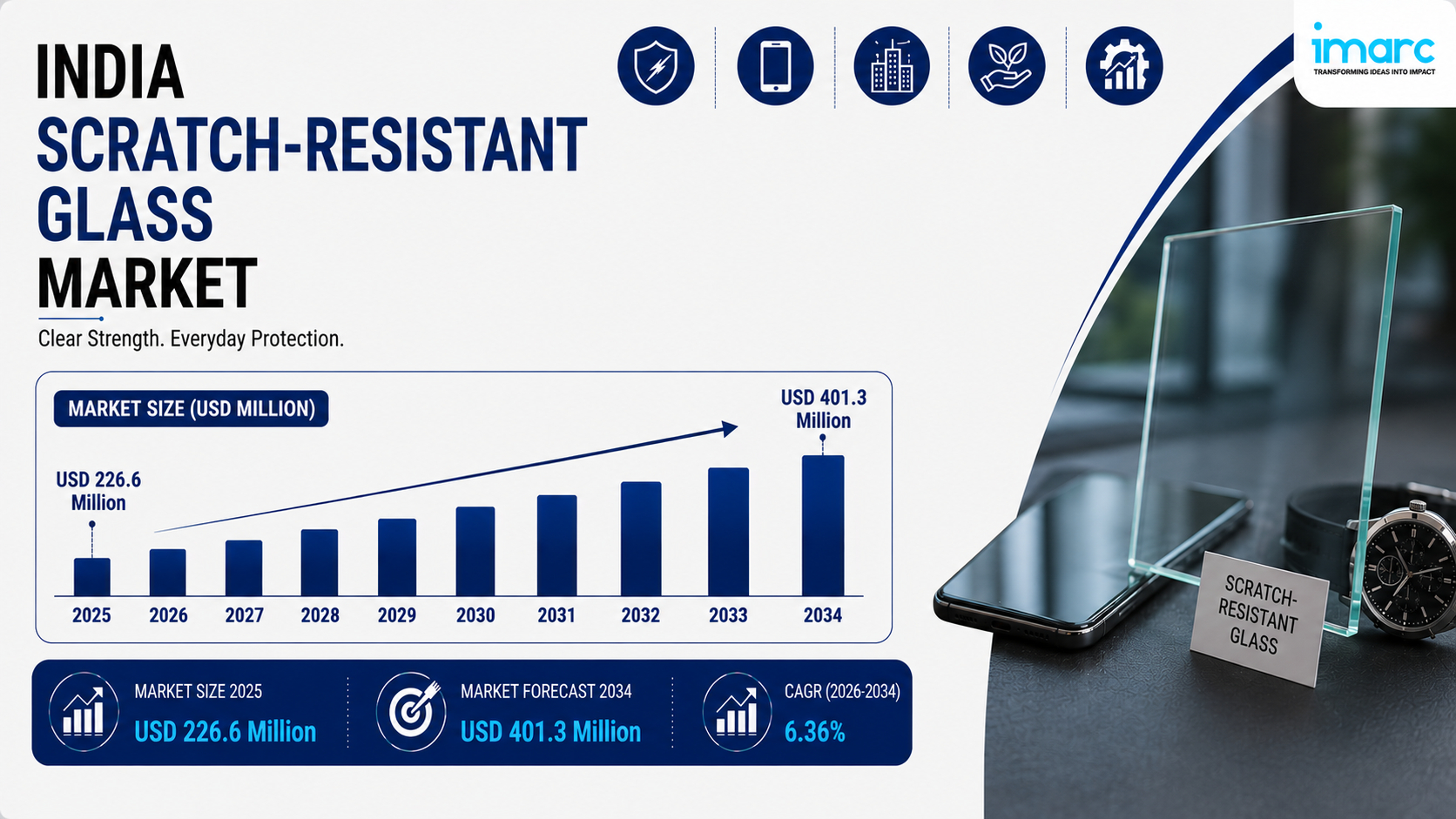
India's scratch-resistant glass market is on a steady climb, valued at USD 226.6 Million in 2025 and expected to nearly double to USD 401.3 Million by 2034, growing at a CAGR of 6.36%. Demand from smartphones, premium watches, and consumer electronics continues to fuel this trajectory.
- That's roughly USD 174.7 Million in fresh value added to the market over the next decade a clear signal of sustained, compounding momentum.
- Corning's Gorilla Armor 2, launched in January 2025 on Samsung's Galaxy S25 Ultra, is pushing premium glass formulations deeper into flagship smartphones.
- OPPO's F27 Pro+ 5G, launched June 2024 with Gorilla Glass Victus 2, shows how smartphone makers keep anchoring the bulk of demand in this category.
- Norqain's Freedom 60 GMT sapphire glass watch (May 2024) shows how luxury timepieces punch well above their weight, commanding premium pricing despite far smaller volumes than smartphones.
- Whirlpool India's Ice Magic Pro Glass Door Refrigerator (July 2024) marks a new front for scratch-resistant glass moving the technology beyond personal devices and into home appliances.
The Strategic Market Challenge: Navigating the Scratch-Resistant Glass Market in India
A structural tension between premium sapphire glass and more affordable chemically strengthened glass continues to shape how this market evolves. Sapphire glass costs considerably more to produce, which keeps it largely confined to luxury watches and high-end devices, while chemically strengthened glass dominates the mass-market smartphone and electronics space at a lower price point. As the market heads toward USD 401.3 Million by 2034, this isn't simply a story of more units sold it's increasingly about which of these two materials gains ground, and how that mix shifts the value captured at each price tier.
India's Strategic Vision for the Scratch-Resistant Glass Market
Industry innovation, far more than government policy, is steering where this market goes next:
- Glass makers like Corning keep pushing the envelope with formulations like Gorilla Armor 2, which adds anti-reflective and display-clarity benefits on top of scratch resistance features that flagship smartphone brands are eager to adopt.
- Smartphone manufacturers are increasingly treating premium scratch-resistant glass as a baseline expectation rather than a luxury add-on, widening the pool of devices that carry this technology.
- The luxury watch industry's embrace of sapphire glass reflects a segment willing to pay a premium for durability paired with refined aesthetics, even as its overall volumes stay modest.
- Appliance makers entering the space, following Whirlpool's example, hint at a broader shift where durability-focused glass starts showing up in categories well beyond phones and watches.
➤ Access Industry-Focused Insights and Future Forecasts - Request Sample Report
Why Invest in the India Scratch-Resistant Glass Market: Key Growth Drivers & ROI
- Smartphones remain the engine of this market: As the dominant application, smartphones and tablets will keep driving most of the activity here, with technologies like Gorilla Glass Victus 2 pushing manufacturers toward higher-spec glass as a competitive differentiator rather than an afterthought.
- Luxury watches punch above their volume: Sapphire glass adoption in premium timepieces Norqain's Freedom 60 GMT being a good example shows how a relatively small number of units can still carry outsized commercial weight, thanks to the willingness of luxury buyers to pay for both style and resilience.
- Display innovation gives smartphones another lever: Corning's Gorilla Armor 2 pairs scratch resistance with sharper, glare-reduced displays, giving phone makers a tangible selling point that goes beyond just "tougher glass."
- Appliances open a new growth lane: Whirlpool's move into scratch-resistant refrigerator doors suggests durability-focused glass could find a home in kitchen and home appliances more broadly a category that's barely tapped today but could meaningfully diversify where this technology shows up next.
India Scratch-Resistant Glass Market Trends & Future Outlook:
- The market is on track to grow from USD 226.6 Million in 2025 to USD 401.3 Million by 2034, a steady 6.36% CAGR that reflects broad-based, multi-category demand rather than a single product spike.
- Chemically strengthened glass will likely keep dominating on sheer volume, given how cost-sensitive most of India's smartphone and electronics market remains.
- Sapphire glass, meanwhile, should keep gaining ground in luxury watches and premium camera lenses, even if it never challenges chemically strengthened glass on unit numbers.
- Anti-reflective and display-enhancing formulations are likely to become standard features in flagship phones, adding another reason for consumers to expect more from their glass than just scratch resistance.
- Expect appliance and consumer durable applications to slowly carve out a bigger role, as more manufacturers take cues from Whirlpool's cross-category move.
Regulatory Landscape & Policy Catalysts in India
- Bureau of Indian Standards (BIS) Electronics and Appliance Quality Standards: BIS compliance requirements shape how manufacturers specify materials across smartphones and appliances, indirectly nudging brands toward more durable, verifiably scratch-resistant glass.
- Make in India Electronics Manufacturing: Government support for domestic electronics assembly opens the door for local sourcing of scratch-resistant glass components, potentially altering cost structures for India-made devices.
- Consumer Protection and Product Durability Standards: Rules around how brands market durability claims push manufacturers toward materials that can actually back up those promises, reinforcing demand for proven scratch-resistant technology.
- Import Duty Structure on Specialty Glass Components: Duties on imported sapphire glass and chemically strengthened glass substrates directly affect what manufacturers pay, shaping how competitively each material can be priced in India.
- Electronics Waste Management Alignment: Broader e-waste regulations intersect with this market in a subtler way durability-focused glass that extends a device's usable life supports circular economy goals without working against the market's natural growth.
➤ Explore the Exact Chapters and Data Scope - Get Full Brochure
Market Segmentation Breakdown and Share Analysis:
Analysis by Process:
- Thermal
- Mechanical
- Laser
- Others
Analysis by Type:
- Crystalline Silicon
- Thin Film
- Others
Analysis by Material:
- Metal
- Glass
- Aluminum
- Silicon
- Others
Analysis by Shelf Life:
- Normal Loss
- Early Loss
Regional Insights:
- North India
- South India
- East India
- West India
By the IMARC Group, the Top Competitive Landscape & their Positioning:
Covering an in-depth analysis of the competitive landscape, market structure, key player positioning, competitive dashboards, top winning strategies, and detailed profiles of all major industry participants you will gain access to all these exclusive insights within the full research report.
Note: If you need specific information that is not currently within the scope of the report, we can provide it to you as a part of the customization.
➤ Align the Report Insights with Your Strategic Goals - Request Customization
Frequently Asked Questions (FAQs):
Q1: What is the current value and projected growth of the India Scratch-Resistant Glass Market?
According to IMARC Group, the India scratch-resistant glass market reached USD 226.6 Million in 2025 and is projected to reach USD 401.3 Million by 2034, growing at a CAGR of 6.36% over the forecast period 2026-2034 nearly doubling along the way.
Q2: What's the difference between chemically strengthened glass and sapphire glass?
Chemically strengthened glass is the more affordable, widely used option across mass-market smartphones and electronics. Sapphire glass costs significantly more to produce but offers superior scratch resistance and clarity, making it the material of choice for luxury watches and premium device components like camera lenses.
Q3: Which application drives the most demand in this market?
Smartphones and tablets lead by a wide margin, given how central phones are to daily life in India and how much consumers now expect durability as standard. Automotive, interior architecture, and consumer electronics including appliances round out the rest of the demand picture.
Q4: How are recent product launches shaping this market?
Launches like Corning's Gorilla Armor 2 (on Samsung's Galaxy S25 Ultra) and OPPO's F27 Pro+ 5G with Gorilla Glass Victus 2 show smartphone brands actively competing on glass technology, treating scratch resistance and display clarity as features worth marketing rather than hidden specs.
Q5: Why does the luxury watch segment matter if its volumes are small?
Even with comparatively few units sold, luxury watches command premium pricing for sapphire glass, as seen in Norqain's Freedom 60 GMT. That willingness to pay for both durability and elegance makes this a steady, margin-friendly corner of the broader market.
Strategic Insight & Verdict
India's scratch-resistant glass market is firmly on track to nearly double, moving from USD 226.6 Million in 2025 to USD 401.3 Million by 2034. What happens next will hinge less on raw unit growth and more on how the mix tilts toward higher-value sapphire glass and increasingly sophisticated smartphone formulations. Based on how these segments are evolving, we at IMARC Group have observed that suppliers betting on premium glass innovation and entry into new categories like appliances are best placed to benefit as this market heads toward its USD 401.3 Million milestone in 2034.
Verified Data Source: India Scratch-Resistant Glass Market Report by IMARC Group
Written by: Tarang Chauhan (Insights Specialist @ IMARC Group)
View my full professional profile and connect with me at [https://www.linkedin.com/in/tarang-chauhan-31a82b265] for exclusive market research insights and B2B growth strategies.