Indian PCB Market Forecast 2026-2034: Size, Share, Top Manufacturers, Industry Insights & Forecast
According to IMARC Group's report titled "Indian PCB (Printed Circuit Board) Market Size, Share, Trends and Forecast by Manufacturing Type, Application, Product Type, Layer, Segment, Laminate Type, and Region, 2026-2034", the report offers a comprehensive analysis of the pcb market in india, including market growth, share, trends, and regional insights.
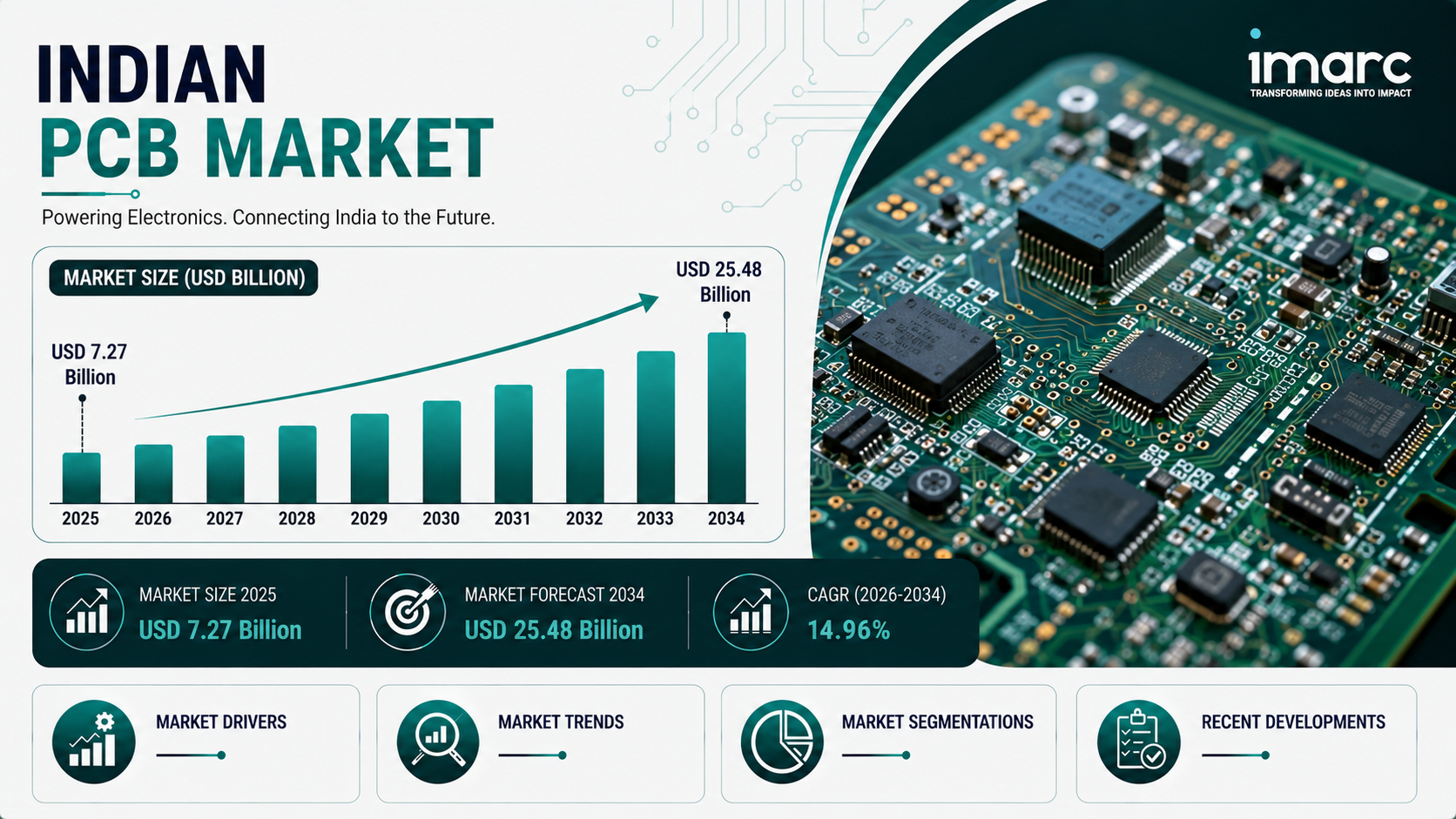
India's printed circuit board (PCB) market reached USD 7.27 Billion in 2025 and is projected to reach USD 25.48 Billion by 2034, growing at a CAGR of 14.96% more than tripling in value. PLI scheme investments exceeding INR 18,863.1 crore for electronics manufacturing, 5G network deployment, EV battery management system demand, and India's semiconductor mission are converging to accelerate the Indian PCB market beyond basic single-sided boards toward advanced multilayer and HDI production.
- Market scale: USD 7.27 Billion in 2025 → USD 25.48 Billion by 2034 at 14.96% CAGR, adding USD 18.21 Billion in incremental annual value.
- PLI scheme driving capacity expansion: The PLI scheme for large-scale electronics manufacturing with INR 18,863.1 crore outlay has triggered investment commitments exceeding INR 5,000 crore in greenfield PCB manufacturing facilities.
- Semiconductor mission creating integrated ecosystem: India's semiconductor mission with USD 10 Billion in incentives is building an integrated electronics ecosystem that will drive downstream PCB demand for chip packaging, testing boards, and substrate manufacturing.
- AT&S environmental leadership validated: In October 2023, AT&S India received top honors at the 48th ELCINA Awards for eco-friendly PCB manufacturing and operational excellence confirming that India's Nanjangud facility meets global environmental and technological standards.
- Fastest-growing segments: Multi-layer PCBs and populated PCBs are the highest-growth categories through 2034, driven by 5G infrastructure, automotive electronics, and expanding domestic EMS operations.
The Strategic Market Challenge: Navigating the Indian PCB Market
India's PCB manufacturing sector faces a structural technology gap in advanced HDI, flex-rigid, and high-layer-count fabrication capabilities concentrated in China, Taiwan, and South Korea that India has not yet replicated at competitive scale. Raw material import dependency for copper clad laminates, specialty chemicals, and prepreg substrates creates supply chain vulnerability to geopolitical disruptions, trade restrictions, and currency volatility. Despite PLI incentives, India's manufacturing scale remains insufficient to capture full domestic demand with Indian manufacturers primarily competing in standard single-sided and double-sided board segments while advanced multilayer procurement continues flowing to overseas suppliers.
India's Strategic Vision for the PCB Market
- PLI scheme for electronics manufacturing (INR 18,863.1 crore): Production-Linked Incentive targets large-scale PCB capacity expansion, attracting FDI into India's electronics value chain and favoring manufacturers meeting minimum investment thresholds for high-volume domestic and export production.
- India Semiconductor Mission (USD 10 Billion): Integrated electronics ecosystem development creating downstream PCB demand for chip packaging, testing boards, and substrate manufacturing with Tata Electronics' Dholera semiconductor Fab creating direct local PCB procurement requirements.
- 30% EV penetration target by 2030: India's EV policy framework FAME scheme and PLI for advanced chemistry cells is accelerating demand for multilayer PCBs in battery management systems, motor controllers, and charging infrastructure electronics requiring high-current handling and thermal management.
- 5G network deployment: Urban and semi-urban 5G rollout is generating substantial demand for high-frequency PCB substrates, antenna modules, and base station electronics with Maharashtra, Tamil Nadu, and Karnataka's established manufacturing clusters positioned as primary beneficiaries.
➤ Access Industry-Focused Insights and Future Forecasts - Request Sample Report
Regulatory Landscape & Policy Catalysts in India:
- PLI scheme for electronics manufacturing (INR 18,863.1 crore) provides output-linked financial incentives that favor scale manufacturers accelerating consolidation among Indian PCB producers and creating investment-grade returns for committed capacity expansion programs.
- India Semiconductor Mission (USD 10 Billion) building integrated electronics manufacturing clusters creates coordinated downstream PCB demand with semiconductor fabs requiring testing boards, substrates, and packaging PCBs that Indian manufacturers can supply from co-located facilities.
- Make in India defence procurement preferences for domestically manufactured military-grade PCBs create a protected long-term demand segment that justifies the quality management and reliability certification investment required for defence electronics supply chain qualification.
- RoHS and environmental compliance mandates for electronics manufacturing including lead-free soldering and sustainable manufacturing practices are setting quality and environmental standards that organized certified manufacturers like AT&S India meet, creating competitive differentiation from unregulated smaller producers.
- 5G spectrum allocation and network deployment policy creating structured telecom infrastructure investment cycles generate predictable high-frequency PCB procurement demand that manufacturers can plan production capacity expansions against.
- Electronics manufacturing cluster policy establishing dedicated industrial parks with shared utilities, testing infrastructure, and skilled workforce training programs in Maharashtra, Tamil Nadu, Karnataka, and Gujarat reduces investment barriers and operating costs for PCB manufacturers establishing new facilities.
Why Invest in the Indian PCB Market: Key Growth Drivers & ROI
- PLI and semiconductor mission creating a multi-decade manufacturing investment cycle: India's government is investing USD 10 Billion in semiconductor manufacturing and INR 18,863.1 crore in electronics PLI creating a self-reinforcing demand cycle where semiconductor fabs require PCB substrates and testing boards, electronics OEMs require PCB assembly, and export-oriented EMS companies require competitive domestic PCB sourcing to build India-based global supply chains.
- 5G and IoT proliferation driving advanced PCB adoption beyond consumer electronics: 5G base station electronics, IoT sensor networks for smart cities, and industrial automation applications are creating demand for multilayer and high-frequency PCBs with stringent signal integrity requirements a premium segment growing faster than the 14.96% overall market CAGR and commanding significantly higher margins than standard single-sided board production.
- EV transition creating specialized premium PCB demand: India's EV adoption trajectory is generating multilayer PCB demand for battery management systems and power electronics requiring high-current handling, thermal management, and automotive-grade reliability a segment requiring technology investment and certification that creates durable barriers protecting early entrant manufacturers from commodity price competition.
- Defence electronics indigenization creating protected high-reliability demand: India's defence procurement policy mandating indigenous content requirements creates a protected domestic demand segment for military-grade PCBs with stringent reliability standards providing manufacturers meeting defence quality requirements with long-term government procurement contracts that reduce commercial market cyclicality exposure.
➤ Explore the Complete TOC and Data Coverage - Get Full Brochure
Indian PCB Market Trends & Future Outlook
- Multi-layer PCBs at 19.6% layer share growing fastest, driven by smartphones, networking equipment, defence electronics, and medical devices requiring increasing circuit complexity that single and double-sided boards cannot accommodate.
- Populated PCB segment (26% of manufacturing type) expanding faster than bare boards as domestic EMS companies scale assembly operations in response to PLI-driven electronics OEM localization.
- Automation investment AOI, laser direct imaging, CNC drilling improving Indian PCB yield rates and defect density toward global competitive benchmarks required for premium segment market access.
- Maharashtra (29%), Tamil Nadu (21.6%), Karnataka (18.4%) maintain manufacturing cluster leadership, while Gujarat and Karnataka represent the fastest-growing investment destinations through 2034.
- RoHS compliance and high-frequency laminate adoption are enabling Indian manufacturers to serve telecommunications and automotive applications with lead-free processes and signal integrity requirements expanding the addressable premium market segment.
By the IMARC Group, the Top Competitive Landscape & their Positioning:
- AT&S
- Epitome Components Ltd.
- Shogini Technoarts
- Cipsa Tec India Pvt Ltd
- Sulakshana Circuits Ltd
- PCB Power Limited
- Hi-Q Electronics Pvt Ltd
- Vintek Circuit India Pvt Ltd
- India Circuit Ltd (Garg Electronics)
- Nano Electrotech Pvt Ltd
- Meena Circuit Pvt Ltd
Covering an in-depth analysis of the competitive landscape, market structure, key player positioning, competitive dashboards, top winning strategies, and detailed profiles of all major industry participants you will gain access to all these exclusive insights within the full research report.
Market Segmentation Breakdown and Share Analysis:
Analysis by Manufacturing Type:
- Bare PCBs (74.0% market share)
- Populated PCBs (26.0% market share)
Analysis by Application:
- Consumer Electronics
- Communication
- Industrial Electronics
- Computers
- Military & Aerospace
- Automotive
- Medical Instrumentation
- Others
Consumer electronics lead with a 35% market share in 2025, supported by India’s electronics manufacturing value rising sixfold over the past decade to INR 11.3 lakh crore.
Analysis by Product Type:
- Rigid 1-2 Sided
- Standard Multilayer
- Flexible Circuits
- HDI/Microvia/Build-Up
- Rigid Flex
- Others
Rigid 1–2 sided PCBs account for 50% of the market in 2025, favored for cost efficiency, offering 40–50% lower per-unit costs than multilayer alternatives.
Analysis by Layer:
- Single-Sided (53.0% market share)
- Double-Sided (27.4% market share)
- Multi-Layer (19.6% market share)
Analysis by Segment:
- Rigid PCBs
- Flexible PCBs
Rigid PCBs dominate with an 82% market share in 2025, essential for automotive control systems and consumer electronics motherboards.
Analysis by Laminate Type:
- FR-4
- Polyamide
- CEM-1
- Paper
- Others
FR-4 leads with a 61% share in 2025, serving as the standard material balancing performance and cost for mainstream electronics.
Regional Insights:
- Maharashtra (29.0% market share)
- Tamil Nadu (21.6% market share)
- Karnataka (18.4% market share)
- Gujarat (15.3% market share)
- Other States (15.7% market share)
Note: If you need specific information that is not currently within the scope of the report, we can provide it to you as a part of the customization.
➤ Align the Report Insights with Your Strategic Goals - Request Customization
Frequently Asked Questions (FAQs):
Q1: What is the current value and projected growth of the Indian PCB Market?
According to IMARC Group, the Indian PCB market reached USD 7.27 Billion in 2025 and is projected to reach USD 25.48 Billion by 2034, growing at a CAGR of 14.96%, driven by PLI scheme electronics manufacturing investment, 5G deployment, EV PCB demand, semiconductor mission ecosystem development, and defence electronics indigenization.
Q2: Which manufacturing type, layer, and regional segments lead the market?
Bare PCBs lead manufacturing type at 74% in 2025 for cost-competitive consumer electronics production. Single-sided PCBs lead layer segment at 53% for high-volume LED, power supply, and consumer applications. Maharashtra leads regionally at 29%, followed by Tamil Nadu at 21.6% and Karnataka at 18.4% reflecting established electronics manufacturing cluster concentration.
Q3: How is the PLI scheme transforming India's PCB manufacturing landscape?
The PLI scheme with INR 18,863.1 crore outlay has triggered investment commitments exceeding INR 5,000 crore in greenfield PCB facilities attracting FDI and domestic capital into capacity expansion that was previously uneconomical without policy incentives. PLI-linked consolidation is expected to favor large-scale manufacturers meeting minimum investment thresholds over fragmented smaller producers currently dominating standard board segments.
Q4: What are the fastest-growing PCB segments through 2034?
Multi-layer PCBs are growing fastest in the layer segment, driven by 5G, smartphones, networking, and defence applications requiring high component density. Populated PCBs are growing fastest in manufacturing type as EMS companies scale domestic assembly operations. EV-specific multilayer boards for battery management systems and motor controllers represent the premium segment with the highest per-unit value growth trajectory.
Q5: What are the primary challenges and opportunities for India's PCB industry through 2034?
Opportunities include semiconductor mission integrated ecosystem demand, 5G high-frequency PCB procurement, EV battery management multilayer demand, and defence electronics indigenization. Challenges are advanced HDI and flex-rigid technology gaps requiring significant capital and technology transfer, raw material import dependency creating supply chain vulnerability, and the skilled technician shortage constraining advanced fabrication process scale-up.
Strategic Insight & Verdict
India's PCB market is transitioning from a low-cost standard board producer toward an advanced electronics manufacturing ecosystem driven by PLI investment, semiconductor mission integration, and 5G/EV technology adoption creating premium multilayer demand. Based on our analysis, we at IMARC Group have observed that PCB manufacturers combining multilayer and HDI technology capability, PLI-scale production commitment, and defence or automotive electronics certification are best positioned to capture value as the market scales toward USD 25.48 Billion by 2034.
Verified Data Source: Indian PCB (Printed Circuit Board) Market Report by IMARC Group
Written by: Tarang Chauhan (Insights Specialist @ IMARC Group)
View my full professional profile and connect with me at [https://www.linkedin.com/in/tarang-chauhan-31a82b265] for exclusive market research insights and B2B growth strategies.